
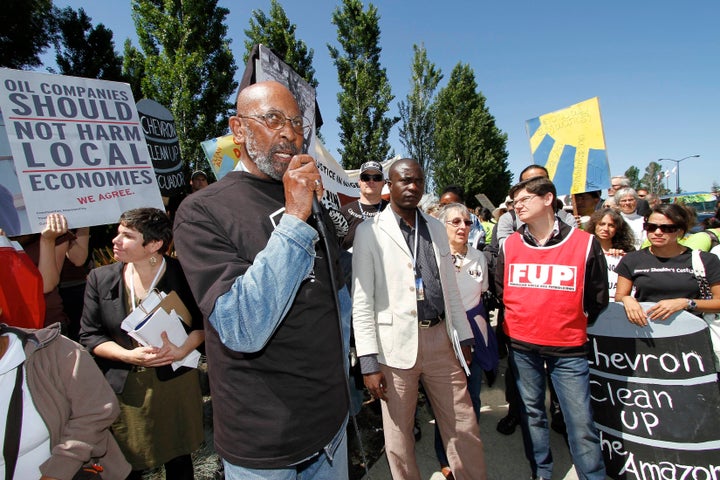
Andrés Soto remembers the first time his parents allowed him to walk to a friend’s house after dark. As he made his way down the street in Richmond, California, where he lived, he could see a massive flame shoot up into the air from the refinery in the distance.
“You know, I was 10 years old. I thought it was hella cool,” Soto says. “But now I know that’s flaring and that it was being done to burn off an imbalance of gases to prevent an explosion.”
The Chevron refinery looms large in Richmond — physically, but also in the affairs of its residents and government. On Jan. 22, the city filed a lawsuit against the multinational and 28 other oil, gas and coal companies ― including BP, Exxon and Shell ― for knowingly contributing to climate change.
A climate change adaptation study commissioned by the city revealed challenges it will face by 2100. It found that the city’s current levees will not protect it against rising sea levels and its water supply, sourced from runoff from the Sierra Nevada Mountains, is vulnerable to drought.
“We have two rail lines, 3,000 acres of public waterfront parks, vulnerable neighborhoods, two wastewater treatment plants, and a refinery, all subject to inundation,” said Richmond Mayor Tom Butt in a press statement.
Richmond is the ninth U.S. community in less than a year to take major fossil fuel companies to court, alleging that the industry has known for 50 years that its products significantly impact the Earth’s climate yet concealed these dangers from the public. It joins New York City and seven California communities, including San Francisco, Oakland, Santa Cruz and San Mateo County, in seeking damages to help pay for infrastructure projects related to sea level rise.
Chevron spokesman Braden Reddall called the lawsuits counterproductive in an email, saying they will do nothing to address “the serious issue of climate change.” He added, “Reducing greenhouse gas emissions is a global issue that requires global engagement.”
But residents in the communities that have sued are cautiously optimistic. Soto, now a community organizer in Richmond with Communities For a Better Environment, says he’s delighted to see the city file the latest lawsuit. The effects of climate change are on the community’s mind, he said, from California’s droughts to recent devastating wildfires.
“I have never seen that kind of air quality in my entire life living in the Bay Area and I’m 62 years old,” Soto said of the wine country fires in October and the smoke they generated, which affected the entire region. “It was dense. It was dark. It was blocking out the sun. Everything was red,” he added. “To us, these are all evidence of climate change. And the fact that the petrochemicals industry knew they were doing this to the planet and covered it up is why Richmond and these other cities are saying, ‘Enough’s enough.’”
Surrounded by water on three sides, Richmond, with a population of 107,500, is home to some of the poorest communities in the San Francisco Bay Area. Chevron is the city’s largest employer.
“They just don’t care. They just care about the profit, how much they can make money,” lifelong Richmond resident Torm Nompraseurt, who is an organizer with the Asian Pacific Environmental Network, said of Chevron’s attitude to climate change.
Source: Huffingtonpost News

 Hello, my name is Jack Sparrow. I'm a 50 year old self-employed Pirate from the Caribbean.
No comments:
Post a Comment