
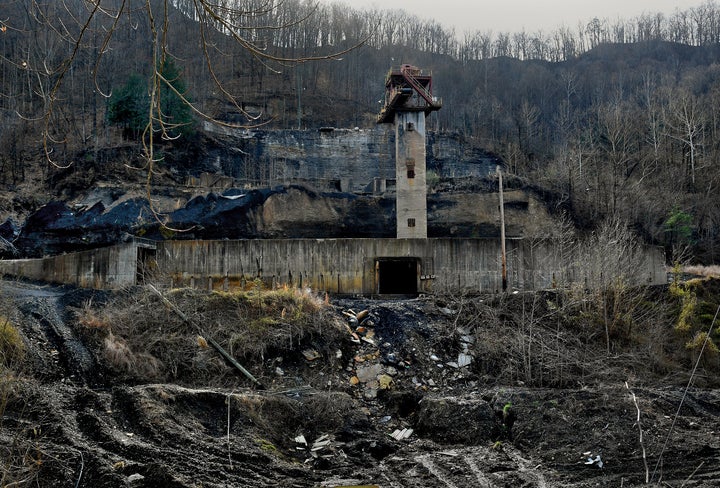
“Every winter, the water goes off,” she said. “For days. Then you have to boil it for days.”
Brashear’s water was out for eight days, which she said pales in comparison to her neighbors up the mountain who had none for nearly a month. The county government handed out bottled water, which she saved — her family doesn’t drink the tap water anyway because of its sulfur-like taste — and she hiked up a coal bank nearby to carry five-gallon buckets of clean creek water to fill the toilet and brush her teeth.
“People were calling the county every day,” she said. “When I called, I asked them how long it would be. They’d say, ‘No ma’am, no idea, might be tomorrow.’”
Viper is an unincorporated community — an area without its own municipal government — a few miles up the road from Hazard in Perry County, an Appalachian coal mining community with a 30 percent poverty rate. The water is sourced from the nearby Kentucky River and controlled by Hazard Utilities, though many people still use well water because they say the utility’s water is unreliable. When freezing temperatures slammed the Southeast earlier this winter, the utility reported that major waterline breaks and a water shortage from some of its 9,000 customers letting their faucets run (done to prevent pipes from freezing) caused the shutoffs.
The crumbling infrastructure here is just a snapshot of the larger water crisis in the U.S. In 2017, the American Society of Civil Engineers (ASCE) gave the U.S. a “D” in drinking water infrastructure. According to ASCE, the U.S. loses about 6 billion gallons of treated water everyday, making it a $1 trillion problem to fix.
“It’s in pretty tough shape,” said Greg DiLoreto, a retired water utility executive and chair of ASCE’s infrastructure committee. “It has a huge effect on our economy, and puts a big burden on small and rural communities.”
In Appalachia, as the coal industry has waned, the money that local governments receive from coal severance tax funds (a fee on the amount of coal extracted) — which helped pay for utility and other infrastructure upgrades — has drastically decreased. And as the water shuts off or runs out more frequently, with little communication to customers, it has huge ripple effects on communities: businesses have to shut down, workers get sent home and lose wages, and schools close. American families lose $3,400 a year because of poor infrastructure, DiLoreto said, thanks to lost wages or expenses like buying bottled water or fixing their cars because of potholes.
“Mostly, I think folks don’t really know what to do,” said Ivy Brashear, Pam’s daughter and the Appalachian Transition Coordinator at Mountain Association for Community Economic Development. “Inevitably [the county] will be able to put small patches on what the problem was, but obviously that’s literally just putting a Band-Aid on a broken system.”
There are large-scale solutions to address these types of basic infrastructure problems. In January, a Kentucky lawmaker introduced a bill to combine some eastern Kentucky counties so they can better pool resources. Perry County recently hired a full-time grant writer to find more funding for economic development initiatives, especially those that use abandoned mine land or Appalachian Regional Commission funds.
Some utilities in cities like Milwaukee and Washington, D.C., are selling biosolids from wastewater treatment to fund water infrastructure improvements; in other places, private water companies are buying out smaller, struggling public water companies.
Source: Huffingtonpost News

 Hello, my name is Jack Sparrow. I'm a 50 year old self-employed Pirate from the Caribbean.
No comments:
Post a Comment